

What would it take to make car-free living possible across the United States? The question has critical implications for the climate: Transportation is the nation’s top source of emissions, and everyday vehicles are the largest contributor within this category.
Today, cars are an inescapable fact of life in most of the country. Almost 70% of U.S. workers drove alone to work in 2022, compared to 2.9% who biked or walked and 3.1% who took public transportation.
This reality doesn’t necessarily reflect Americans’ preferences, however. Many people in the U.S. want to live in walkable areas, but only a small fraction of the nation’s developed land fits this description. Around 90% of all housing in the nation’s largest metro areas is located in car-centric suburbs. The low supply of real estate in walkable neighborhoods drives prices upward, making it unaffordable for most people.
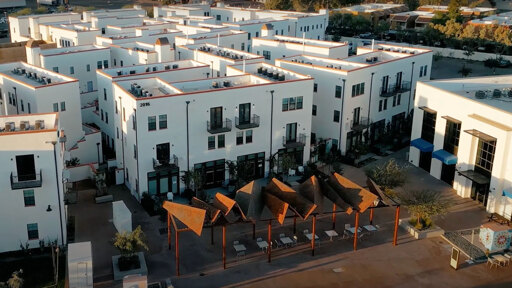
Ryan Johnson has spent years thinking about solutions for these problems. Inspired by travels to European cities, he cofounded Culdesac, a real estate developer dedicated to building walkable places, in 2018. In 2023, the company opened the first phase of Culdesac Tempe, a 15.5-acre development that offers a variety of transportation options – but no resident parking.
Yale Climate Connections spoke with Johnson about Culdesac Tempe and the future of American cities.
As I commented in another thread, they chose this location because of Waymo access. No resident parking, sure, but not exactly car free.
