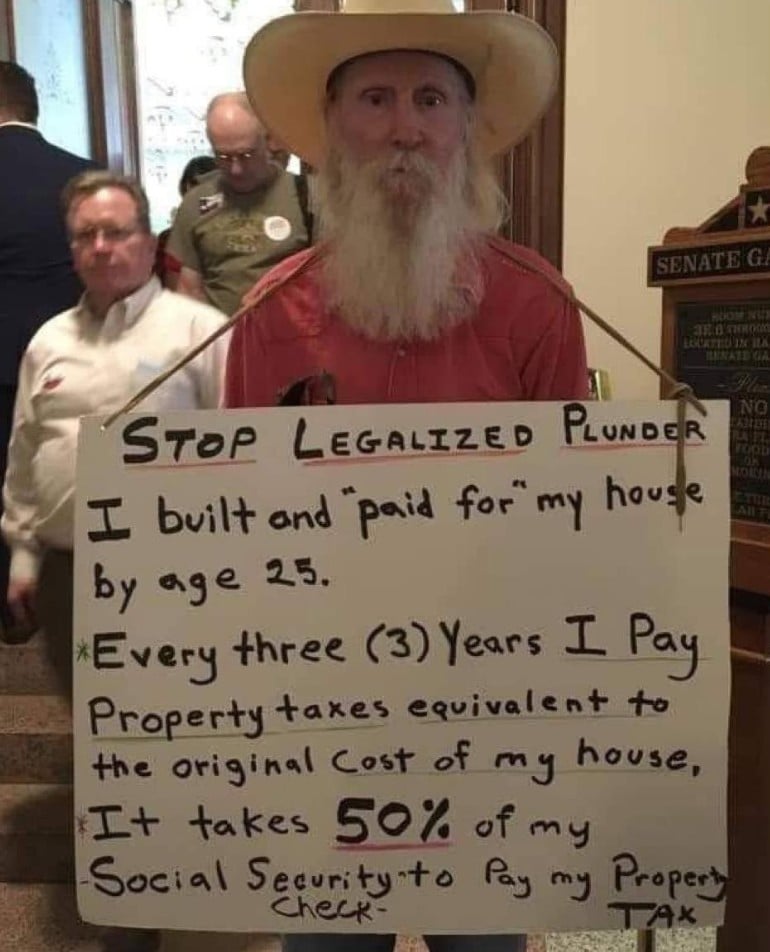
I don’t understand inflation, so as an old landowner I think I shouldn’t have to pay taxes.
Property taxes do hit retired people differently though. Taxing based on what the government says your land is worth instead of your income is absolutely meant to create opportunities for real estate agents and developers at the expense of the people living there.
Taxes based on assets tax those with assets, instead of income taxes which tax those who work.
If old man owns such a valuable piece of land, he deserves to pay his fair share for the public services he used.
It’s like saying you don’t want to pay for schools because you’re not a student.
The fact that schools are funded by the surrounding area is crap and needs to change. He’s retired with a social security income. He paid into the system his entire life already. Telling him he must sell and move out because he’s not wealthy enough is exactly what we should be working against. It’s a system by the wealthy, for the wealthy.
For many states property taxes are the majority of funding for public schools. If that’s the case for the pictured person, the sign could also read:
“I got my public education for free from age 5-18 funded from others paying property taxes including learning how to read and write to make this sign you’re reading. Now that I’ve received that free public education and benefited from it, I’m not interested in paying for any kids to be educated using my dollars. F you, I got mine.”
We could also just pay for education differently.
Yes and. How most of the US funds their school system is super fucked up. Here in Canada, primary education is paid for by the province, and school funding is based on student enrollment numbers. This translates to much more equal levels of education, regardless of how wealthy a given neighborhood may be. I was shocked to find out that schools are paid for by catchment area taxes in must of the states - it makes the history of redlining so obvious when the is literally a “wing side of the tracks”.
How big is his house? How much is it worth now?
How much did he pay for the land it sits on? Or did he inherit that?
Who does he think maintains road networks and all the other infrastructure he relies on?
While these are fair questions, I think it’s a reasonable stance to take that you shouldn’t literally get taxed out of your home if you come into poverty, which unfortunately can include Social Security recipients. I know we all need to pay taxes and contribute to society to the extent that we’re reasonably able to, but I’m not so sure this is the best way to make it happen. For property beyond your primary residence, sure, but for your only home, I don’t super like it.
If your home is now worth millions, you’re now rich and can afford the taxes. If you have no income, sell the house. If you want to live in it, do a reverse mortgage. If you want to pass on your house to your heirs, creating generational wealth while not paying your share of taxes now, fuck you, pay up.
Assuming the house is worth millions is a faulty premise. Housing prices have exploded in the last 5-10 years, and that can mean that a home bought decades ago is worth many times its original value, causing a huge increase in property taxes, but still being in line with other regular homes. People who bought decades ago might have had the home appreciate to 10x the value of initial purchase, just to end up still in line with median home prices. Selling their house won’t fix the tax rate, it’ll just add some leftover mortgage value after they pay taxes on the profit from selling their massively value-inflated home. So now, instead of just paying property taxes, they pay comparable property taxes and the remainder of a new mortgage.
I can agree on inheritance taxes, but I don’t think it’s super fair to heavily tax the owner a primary home of a reasonable value when they’re not selling the home, giving it away, allocating it through inheritance, or otherwise transferring it. Maybe if it’s a mansion, but a simple, normal home, maybe on some farm land? I don’t see a problem with a family having the security of knowing that come hell or high water, they have a home they won’t lose to anything but a natural disaster. We all need to contribute to society as it contributes to us, but I don’t think that should come at the expense of security in basic essentials like housing.
Like I said, do a reverse mortgage. You shouldn’t get to lock in minuscule tax rates forever.
And I just don’t agree with that. I don’t think we should have to pay property taxes at all on a reasonably priced primary residence, as set by local and national standards. Housing should be considered more of a right. We all need to contribute to taxes, yes, no dispute there, but I don’t see this as a fair way to do so. Now, if it’s an extra property or a particularly lavish home, yeah, tax the piss out of them. But taxing someone into homelessness should never happen because one of the state’s core goals at least should be seeing that everyone’s basic needs are met, and that includes housing.
I agree it’s reasonable for housing to be a right, but I disagree that home ownership should be a right.
Okay, but how do you intend to accomplish that without costing the government more tax money? The most cost effective first step seems to me to be to just not tax a reasonable primary residence. Providing housing the inhabitants don’t own costs someone money in building and maintaining that property, and since we’re agreeing that housing should be a right, the only way I can see to guarantee that would be through government funding. And we probably should do that for some people, at least those most in need, but what’s the sense in forcing people in poverty out of their home of decades just because they can’t afford the property taxes, especially when that means pushing them into housing the government is actively paying for? Why is it that we can agree that everyone deserves housing, but we can’t agree that they should be able to own that housing? There are other ways to raise that tax money, and the obvious choice is to increase taxes on those with a gross excess, not those who have managed to achieve stability after decades of work.